How do German returns actually work? We sent 18 parcels back to the shops that shipped them (Part 2)
24.09.2026 · 13 min read

Navigation
- What this isThen you actually send a parcel backKey findings at a glanceFirst, the good news, because it sets the trapFive failures that repeat across the 18 returnsThe benchmark you're actually measured againstCheck this against your own operationOne caveat that changes the numbersWhat to take from thisAbout the study (methodology in one paragraph)
18 returns through each shop's standard customer flow. Return labels, carriers, refund speed, refund amounts, and the emails in between.
What this is
This is part 2 of a live test we ran ourselves: 20 fashion shops selling online in Germany (global majors, footwear & outdoor, sustainable D2C, activewear/lingerie/workwear challengers), one real self-funded order each, everything returned through the normal customer flow.
- Part 1 covered what happens before the return: broken delivery promises and boxes with nothing inside them.
- Part 2 (this article) is about the return itself and the money, plus five failures that repeat: exclusions disclosed too late, cross-border return labels, missing return labels, silent deductions, and support volume.
As before: one order per brand is an incident, twenty side by side are a pattern. We name segments, never shops. Full methodology at the end.
Then you actually send a parcel back
Every shop in our test had a returns policy. Most looked excellent: 14 to 30 days, free return shipping, a clean FAQ. If you audited these 20 shops by reading their policy pages only, you'd conclude that returns in German fashion e-commerce are a solved problem.
Then you actually send a parcel back.

Key findings at a glance
- 18 of 20 orders made it to the return stage - two died earlier (one cancellation after payment, one lost parcel; see Part 1).
- Free return shipping is the German standard: ~9 out of 10 completed return flows cost the customer nothing. The two paid outliers charged €2.50 and €4.50.
- When the flow worked, refunds landed within 1-2 days - the fastest in under 24 hours. That, not the legal 14 days, is the benchmark customers now measure every shop against.
- Only 4 of the 20 boxes contained a printed return label. Everyone else relies on portals, accounts or QR codes, and when a QR flow broke, there was no fallback.
- More than a quarter of all money spent in the test did not come back - partly legitimate exclusions, but the recurring pattern was original delivery fees deducted silently.
- Closing a single return case took anywhere from 4 to 11 emails, depending on the shop, in the same market, with the same carrier and the same product type.
- Only 1 in 4 brands offered an exchange as an alternative to a refund - in a market where sizing drives roughly two-thirds of fashion returns.
- Around 95% of completed returns travelled through one dominant national carrier; return tracking worked in all but one case.
- Two shops surprised customers with non-returnable items at the return stage with zero warning at checkout, and one domestic order's return label pointed to another EU country.
First, the good news, because it sets the trap
The German baseline is genuinely high:
- Free return shipping was the standard. Nearly 9 out of 10 completed return flows cost the customer nothing; the two shops that charged (€2.50 and €4.50) were the visible outliers.
- Refunds, when the flow worked, were fast - typically within 1-2 days of the parcel moving; the fastest within 24 hours.
- Tracking worked in both directions in all but one case.
- Around 95% of completed returns travelled through one dominant national carrier.
This is the trap: because the basics are this good, German customers assume the whole process is this good. Every failure below detonates against that expectation.

Five failures that repeat across the 18 returns
1. The item that becomes non-returnable after you've paid for it
An activewear order contained a bottle. At checkout: no warning, no flag, no asterisk. At return stage: the bottle cannot be returned, "for hygiene reasons." In a second case, a sustainable D2C brand's product turned out to be entirely non-returnable, again with nothing at purchase.
It is worth being precise about the law here, because "for hygiene reasons" is doing a lot of unearned work in this market:
- The exclusion is narrow. It covers sealed goods unsuitable for return for reasons of health protection or hygiene, and only once the customer has broken the seal.
- It is not a blanket exemption for anything you drink out of. A bottle that arrives unsealed, or that the customer never opened, sits outside it.
- The disclosure rule is separate and unambiguous: where the right of withdrawal does not apply, the customer has to be told before the contract is concluded: the product page and the order summary, not the returns portal three weeks later.
So the two shops in our test have two different problems that arrive at the same customer. One may be applying an exclusion that does not cover the item at all. The other is applying a real exclusion in the wrong place.
There is also a structural cost neither of them priced. An exclusion discovered at return stage is the one situation in a returns flow with no self-service path. The customer cannot resolve it in a portal, because the portal is what just refused them. It escalates to email by definition, and both of these cases landed in the upper half of our email count.
The fix is cheap: state the exclusion on the product page, in the cart summary and in the order confirmation, and state the condition rather than the category. "Returnable only while the hygiene seal is intact" is information. "Some items cannot be returned" is a trap with a disclaimer on it.

2. Delivered from Germany, returned to another country
A footwear brand delivered domestically, inside Germany. The return label pointed to another EU country. Nothing at checkout suggested it, nothing in the confirmation email. The customer finds out at the parcel shop, reading a foreign address off a label they just printed.
For the customer that is a longer wait for money. For the seller it is more expensive than it looks, because a cross-border return leg is not an exception you absorb on awkward cases. It is the default routing on every single unit that comes back.
The rough shape of it, on general market rates rather than anything we measured:
- a domestic German consumer return runs somewhere around €3-5 a parcel
- a cross-border intra-EU leg is closer to €8-15
- and it reaches the warehouse days later rather than days earlier
- applied to a fashion return rate of 30-40%, the multiplier lands on a third of everything you ship, every month, not on the difficult cases
- a mid-size shop can be paying a six-figure annual premium on return transport alone
That is before counting what the items are worth after an extra week in transit instead of a week back on the shelf, in the season they were bought in.
That is what "the warehouse is in the cheaper country" costs once you price it per return instead of per pallet. It is also the one failure on this list that the customer notices least and the P&L notices most.

3. The return label that isn't in the box
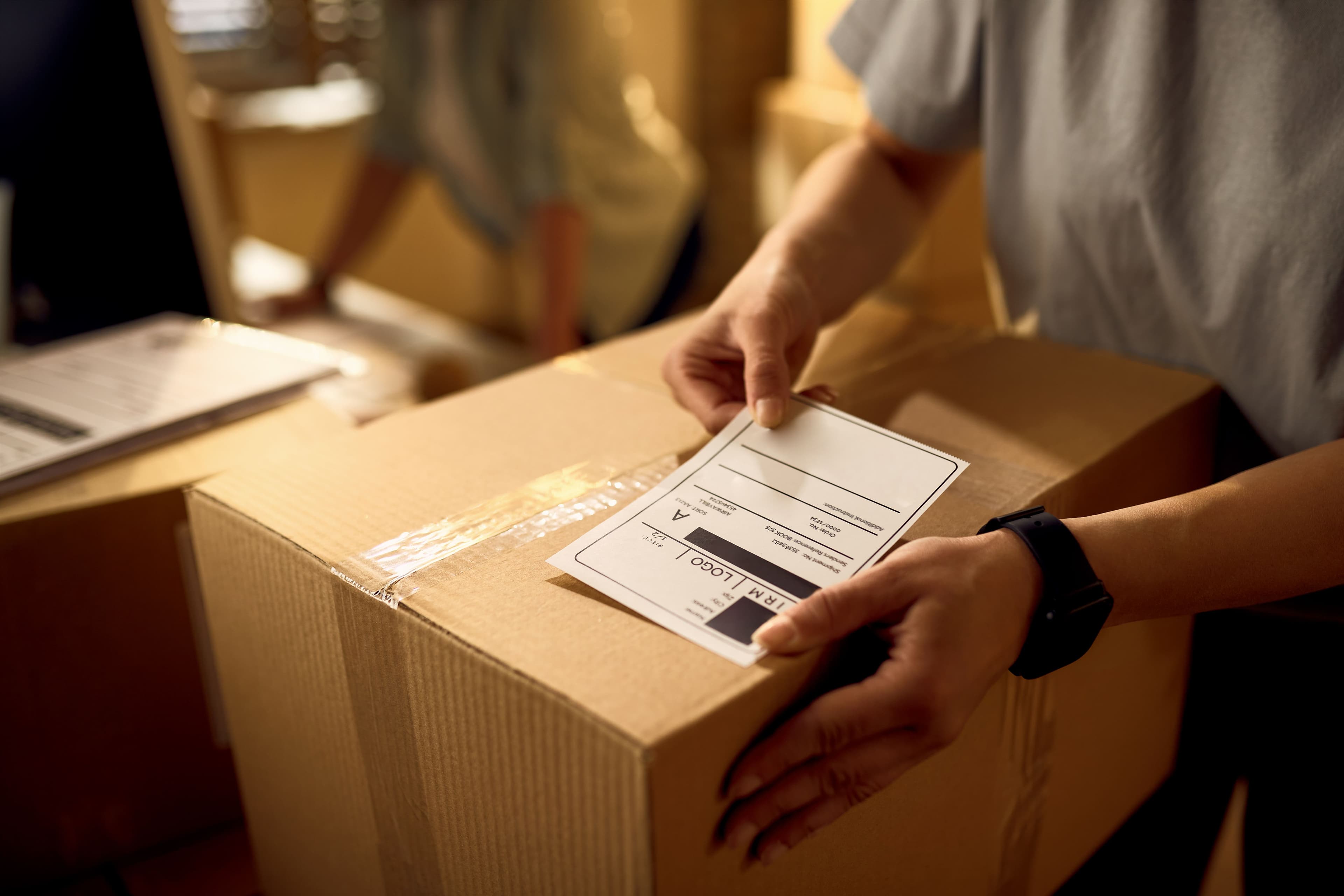
Only 4 of the 20 parcels arrived with a printed return label inside, the one route that works for every customer, including the one who checked out as a guest and never opens their account again. The other sixteen expected the customer to produce one: log into an account, open a portal, or carry a QR code to a counter.
Each route has a specific failure point, and they are not equally bad:
- A portal that requires an account fails for every customer who checked out as a guest. They are asked to log into something they never created.
- A label sent by email on request fails quietly, by adding a day or two before the parcel even moves, inside a window that is only fourteen days long.
- A QR code fails at the counter, which is the worst possible place, because the customer is already out of the house with a sealed parcel under their arm.
That is exactly what happened with one lingerie brand. The QR code had replaced the label entirely, and no printable alternative existed anywhere in the flow. The process stalled, and reaching a human about a failed automated flow turned out to be harder than the return itself. It was the longest single case in our dataset.
The problem is not the QR code. The problem is a QR code as the only path. Every digital return flow needs a printable label reachable in one click, from the order confirmation email, without logging in. If the only fallback is your inbox, your returns process is your support queue.

4. The refund is smaller than the amount paid
Across the eighteen completed returns, over a quarter of the money we paid did not come back to our account. That splits into three parts:
- the two non-returnable items above
- the two shops that charged for return shipping, €2.50 and €4.50, both disclosed in advance, both entirely legitimate
- and the recurring one, which is the pattern that actually matters: refunds quietly reduced by the original outbound delivery fee, deducted with no explanation anywhere the customer would look before shipping the parcel back
Worth knowing what the baseline rule looks like, because it is narrower than most shops assume. On withdrawal, the customer is refunded everything they paid, including the cost of standard delivery. The part a seller may keep is the surcharge: the difference where the customer expressly chose something faster or more expensive than the cheapest standard option on offer. Which means that in a shop with a single delivery option, there is no surcharge to retain.
We are not making a legal claim about any individual shop; we did not see their delivery configurations or their withdrawal information. What we can say is what we measured: money was deducted, and nothing told us in advance that it would be. Any shop can check its own position on this in an afternoon.
And the customer never runs that check anyway. Nobody disputes €4.90. They do the sum once. "I paid €44.90, I got back €40.00, and nobody told me why." Then they either order again or they don't. The shop books €4.90 against a lifetime-value question it will never see the answer to. The fix is three lines in the refund email: what came back, what didn't, why. Disclosing a deduction costs you nothing you were not already keeping.

5. Customer service as the hidden variable
Same country, same carrier, same product category, baskets between €10 and €50. One shop closed the case in four messages. Another needed eleven.
What generates emails five through eleven is not a mystery, and it is not the customer being difficult. In every long case in our dataset the trigger was one of the earlier failures arriving in an inbox:
- a label flow that failed with no printable fallback
- a refund the customer had to chase because the deduction was never explained
- an exclusion discovered at the return stage
Support volume is not a support problem. It is the invoice for the other four.
And eleven emails instead of four is not a service detail. On any realistic cost per contact, the labour on one badly built return can exceed the gross margin on the order that caused it.
The exchange gap sits in the same place on the balance sheet. Only one brand in four offered an exchange as an alternative to a refund. In a market where sizing is consistently reported as the leading driver of fashion returns, that is three quarters of these shops choosing a refund over retained revenue on every wrong-size order they get, answering "wrong size" with: send it back, take your money, start again, possibly with someone else.

The benchmark you're actually measured against
One more time, because it's the number that matters: where the flow worked cleanly, money was back with the customer in 1-2 days. Best case: under 24 hours.
That is the bar. Not the legal 14 days, but the experienced 1-2 days. A customer refunded within 24 hours by one shop does not recalibrate their expectations for you. If your refund takes ten days because the parcel first has to cross a border to reach your warehouse, you are not slightly slower. You are, in the customer's arithmetic, five to ten times slower than the market that trained them.
Check this against your own operation
- Is every non-returnable item flagged on the product page, not in the returns portal?
- What share of your refunds carry deductions the customer wasn't clearly warned about?
- If your QR/portal flow fails, what happens, and how many emails does it take?
- Where does your customer's return parcel physically go? If it crosses a border, does the customer know before buying, and do you know what each crossing costs?
- Can a customer swap a size without a full refund-and-reorder loop?
Then run the same test on yourself: one real order, one real return, one deliberately awkward case: a partial return, a "non-returnable" item, a lost label. Our data shows the failures cluster exactly there.
One caveat that changes the numbers
Everything above was measured in the easiest possible configuration: a domestic order, a domestic return, one country, one carrier, no border. That's the version of this process that works best, and it still broke in five places.
Add distance and every failure on the list gets a multiplier:
- the refund that took two days takes ten, because the parcel has to leave the country before anyone can look at it
- the unprotected item that came back scuffed is now scuffed and three weeks old
- the missing label becomes a customer holding a parcel they don't know where to send
None of these are new problems. They're the same five, measured over a longer distance.
Which is the real finding of this test: returns in Germany aren't broken by policy, they're broken by geography and by the details nobody audits. The shops that performed best weren't the ones with the best returns page. They were the ones where the parcel had the shortest way to travel and someone looked at it quickly. Every unnecessary kilometre a returned parcel travels is margin you will never get back.
What to take from this
- Non-returnable items are disclosed too late. Two shops flagged them only at the return stage, though the law requires it before the contract is concluded.
- A "domestic" return can leave the country. One German order's return label pointed to another EU country: a longer wait for the customer, €8-15 instead of €3-5 per parcel for the seller, on every unit that comes back.
- Only 4 of 20 boxes contained a printed return label. Everyone else relied on a portal, an account or a QR code, and when the QR flow broke, there was no fallback at all.
- More than a quarter of the money spent never came back. The recurring reason was the original delivery fee deducted silently, explained nowhere the customer would look.
- 4 emails or 11 emails - same market, same carrier. Support volume isn't a support problem. It's the invoice for the other four failures.
The policy has been standardised. The experience has not, and your customers run this test on you every single day. They just don't publish the results. They churn instead.
If you want to know what your own flow costs per return, and where in those five steps it leaks, an operational review of one month of your returns is the place to start. That's the layer we build at ShopReturns.
About the study (methodology in one paragraph)
This article is based on a live test we ran ourselves in March 2026: 20 fashion brands selling online in Germany (direct shops only, no marketplaces), spread across four segments (global majors, footwear & outdoor specialists, sustainable/organic D2C brands, and activewear/lingerie/accessories/workwear challengers), one real, self-funded order per brand (baskets of €10-50, delivered to a German consumer address). Of the 20 orders, 18 arrived and were sent back through each shop's standard customer return flow, with no special treatment and no contact identifying us as researchers. For every return we documented: return-label availability (printed, portal, QR), return shipping cost, carrier, tracking in both directions, refund speed and completeness, undisclosed deductions and exclusions, the physical routing of the return parcel, and the number of customer-service emails needed to close the case. Because one order per brand is an incident rather than a statistic, all results are reported as market- and segment-level patterns, and no individual brand is named.
Keep reading
More from the knowledge base

What arrives before the return? We ordered from 20 German fashion shops (Part 1)

What happens if your store does not have the EU withdrawal button yet