Non-EU Brands: €3 Customs Duty Guide (US, AU, CA)
10.07.2026 · 9 min read
Navigation
- Why is this a problem right now?Where does the customs duty money actually leak?What should the ideal returns process look like?What does this mean for Australian clothing brands and your business?Before you scale: a practical seller checklistHow does Shopreturns solve this?FAQNot sure what your current setup is costing you?
Since 1 July 2026, every low-value parcel a non-EU brand ships into the EU pays a €3 customs duty per tariff heading, so for US, Australian, and Canadian ecommerce sellers this is no longer just an import cost-it now hits every return, exchange, replacement shipment, and even returned item that crosses the border again. Returns, not outbound parcels, are now the most expensive leg of selling into Europe, and they determine whether your EU expansion stays profitable, compliant, and customer-friendly at all.
If you sell into the EU from the US, Australia, or Canada, this guide breaks down the new €3 EU customs duty rules, where the biggest cost leaks show up in cross-border returns, why non-EU sellers get squeezed hardest, what an efficient returns process needs to look like, and which practical fixes-from checklists to local returns management and customs handling with Shopreturns-help you reduce charges and keep marketplace and EU requirements under control. Every month you keep running last year's returns model, you are paying the duty twice on exchanges, writing off returnless refunds, and losing customers who waited two weeks for their money back.

Why is this a problem right now?
Legal changes hit all at once. The EU's €150 duty-free threshold ended on 1 July 2026, removing the low-value customs duty exemption for Business-to-Consumer distance sales of imported goods valued at €150 or less and replacing it, while VAT still applies, with a flat €3 duty per tariff heading on e-commerce goods sold from outside the EU by IOSS-registered non-EU sellers, including those in the U.S. This €3 duty is a transitional measure running until 1 July 2028. Under Council Regulation (EU) 2026/382, the exemption originally introduced for low-value consignments is replaced under the new rules now in force. The next stage is set out through the Commission Delegated Regulation, with standard processes moving to the EU Customs Data Hub from 1 July 2028. On top of that, since June 2026 Directive 2023/2673 requires a visible digital "withdrawal button" in every EU purchase flow, making returning as easy as buying. And national fees are stacking: France charges €2 per HS6 code, Italy adds €2 per import, with a separate handling fee for customs processing still possibly being introduced around November 2026.
Marketplaces raised the bar. Amazon, Zalando and eBay increasingly expect local return handling in each market. Without a local EU return address, Amazon can issue returnless refunds: you refund the money and never see the product again.
Distance amplifies every cost. A UK seller absorbs these changes with a two-day Channel crossing. A brand in Colorado, Queensland or Ontario absorbs them across 8,000 kilometres, where every customs formality, transit day and fee gets multiplied. Ironically, US, Australian and Canadian sellers have seen this movie before, just from the other side: the US killed its $800 de minimis in 2025, Australia scrapped its GST-free import threshold back in 2018, and Canada has lived with a CAD 20 threshold for years. The lesson from all three markets is the same: the sellers who lose are not the ones who pay the fee, but the ones who pretend their old logistics model still works, even as policymakers try to level the playing field for cross-border ecommerce.

Where does the customs duty money actually leak?
Mistake 1: shipping replacements from your home warehouse. In the eyes of EU customs, a replacement parcel is a brand new import. New consignment, new €3 (or €6, or €9) in duty, new clearance risk and separate charges can arise when a parcel contains products with different HS codes or a different tariff classification, since multiple items with different tariff codes may be charged per item. If goods are made in China, shipping them from another country does not change their Chinese origin for customs purposes. Every exchange fulfilled from the US, Australia or Canada now pays the duty twice.
Several identical products with the same description, same origin, and identical products under the same HS codes are usually treated as one customs item for this €3 charge.
Mistake 2: sending returns back across the ocean one parcel at a time. Take a real scenario: a €68 skincare order from Denver to Munich costs about €14 in shipping plus €6 in duty on the way out. When the customer returns it, the brand pays another €18 to €25 for return shipping, the parcel spends 10 to 15 business days in transit, and it clears US import processing on arrival. The declaration process also depends on accurate customs descriptions and correct Harmonized System codes for duty calculation, because customs authorities can raise fees or even destroy parcels when contents are misstated. One unhappy customer on a €68 order consumes €40 to €55 in logistics and duties and three to five weeks of calendar time.
Mistake 3: refunding too slowly, or refunding without the product. EU consumers have a 14-day withdrawal right and expect their money fast. If your refund waits for a transatlantic parcel, you risk chargebacks, negative reviews and damaged marketplace metrics. And when retrieving a €30 item costs €25 in reverse logistics, many brands default to "keep the item" refunds, a hidden write-off that scales with every EU order you win.
What should the ideal returns process look like?
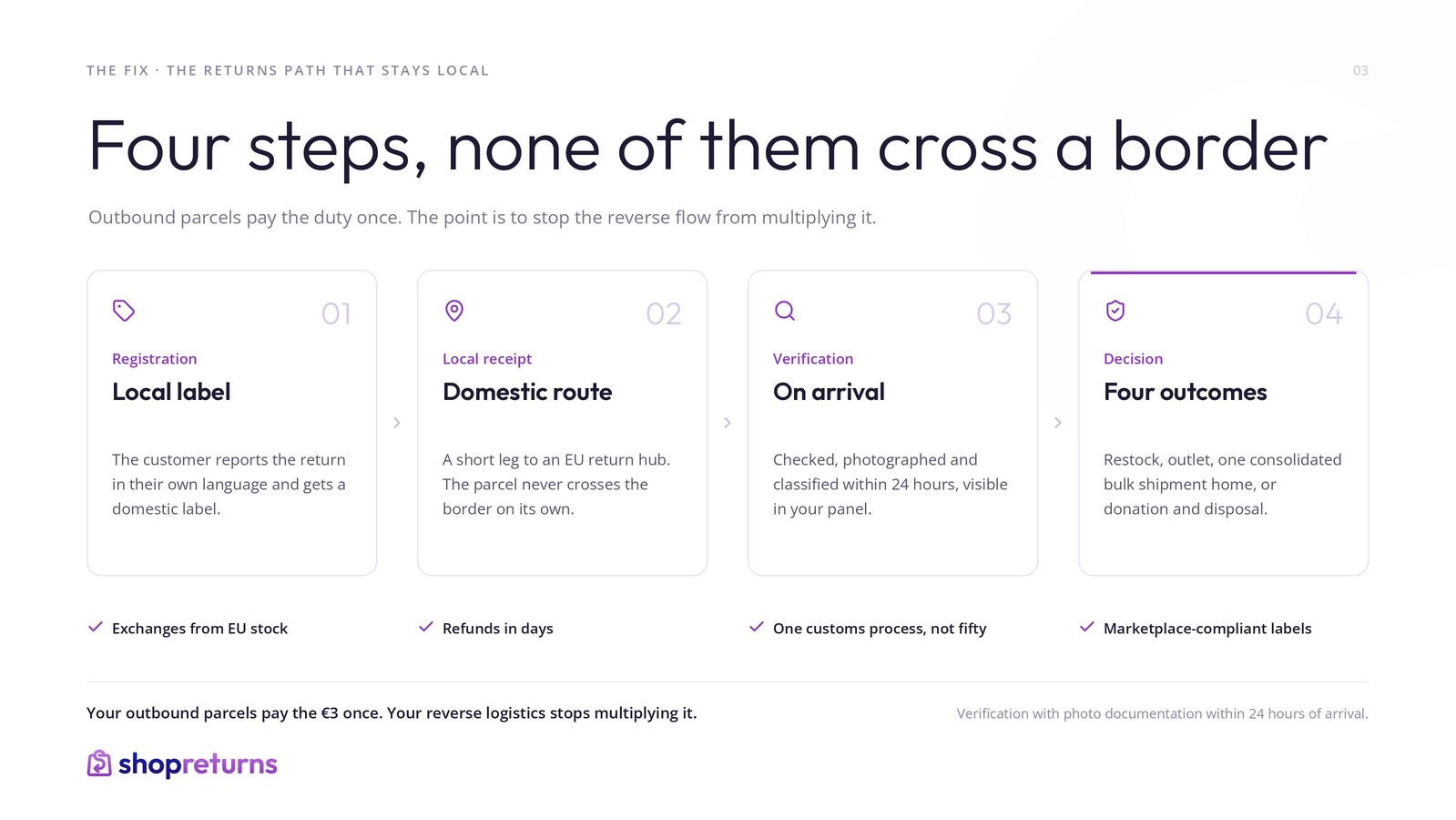
- Registration: the customer reports the return online through a dedicated returns portal, with a local return label in their own language.
- Local receipt: the parcel travels a short domestic route to a return hub inside the EU, never crossing the EU border on its own.
- Verification: the item is checked, photographed and classified within 24 hours of arrival, and the status appears in your panel immediately. At this stage, local teams should also confirm the customs data for low-value goods and make sure the customs description clearly defines the product before any onward movement or consolidation.
- Decision: based on clear rules, each item goes back on the shelf, to an outlet channel, into a consolidated bulk shipment home, or to donation or disposal. Exchanges are fulfilled from verified returned stock already inside the EU, so no replacement ever pays the duty a second time.
What does this mean for Australian clothing brands and your business?
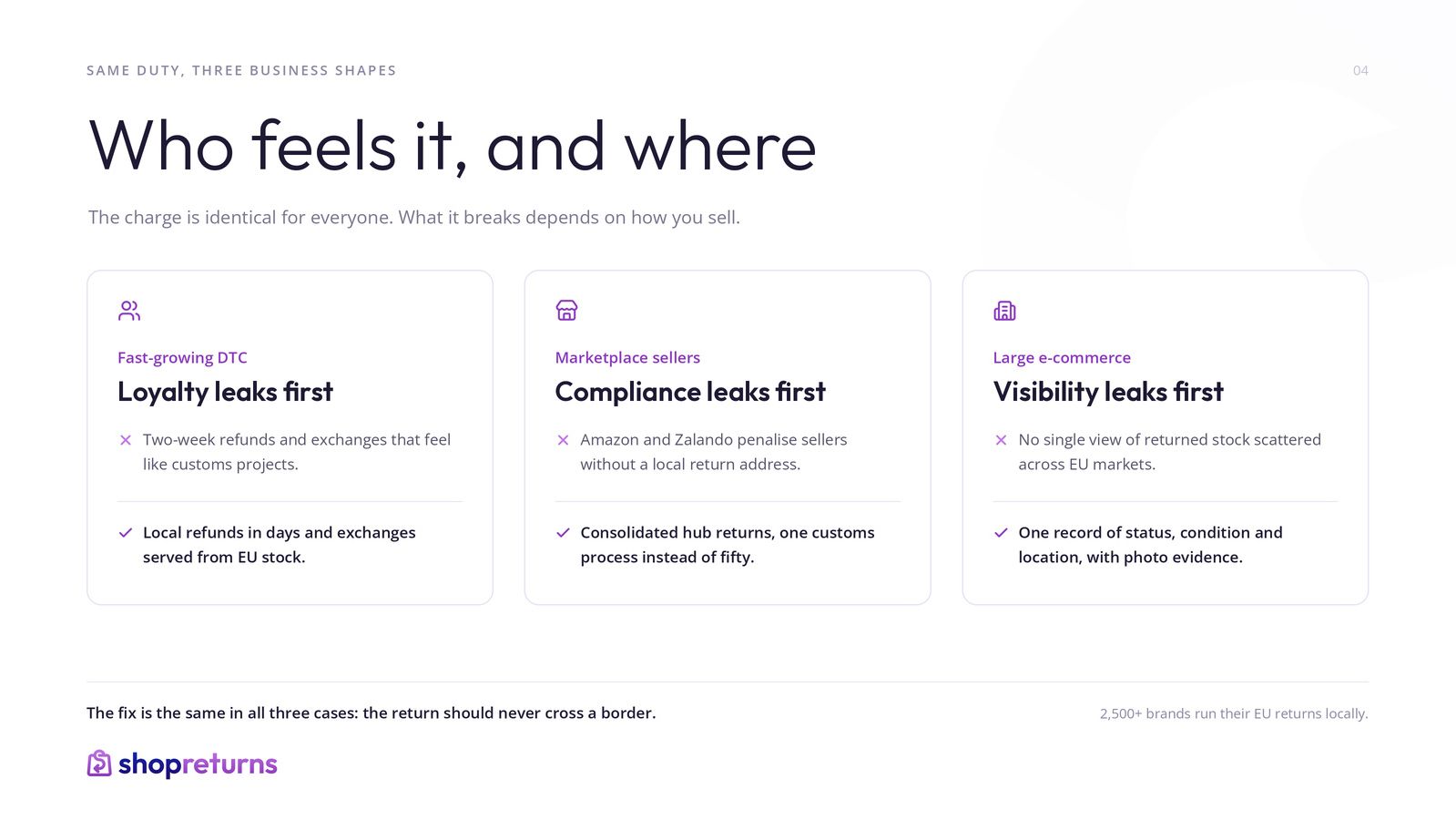
Fast-growing DTC brands (US, AU, CA). Challenge: losing hard-won customer loyalty because refunds take two weeks and every exchange feels like a customs project. Solution: a clean, local return experience that improves the customer experience, with refunds issued in days instead of weeks and exchanges served from EU-based stock to keep the customer experience clean from purchase through refund. Loyalty and LTV grow instead of churn.
Cross-border sellers on marketplaces. Challenge: enormous costs of sending single parcels back across borders and duties, plus Amazon and Zalando compliance requirements that punish sellers without local return addresses-a problem that affects many sellers operating cross-border, not just a few edge cases. Without IOSS-style upfront collection, buyers may face carrier handling fees at delivery, creating a worse customer experience. Return-related customs costs under the new duty are typically non-refundable, which makes repeated cross-border movements especially expensive. Preferential origin can reduce or eliminate customs duty, including the €3 fee, but only if goods qualify for preferential treatment under relevant EU trade agreements and meet the required origin rules. That depends on the country of origin-the country where goods were genuinely manufactured or sufficiently processed-not whether they shipped from a uk warehouse or another location, and further guidance is still pending on how the EU will confirm and declare this for low-value shipments. Solution: returns consolidated at local EU hubs and shipped home in bulk on your schedule, one customs process instead of fifty, with full marketplace compliance (including Amazon Prepaid Return Labels).
Large e-commerce and enterprise. Challenge: no single view of returned inventory scattered across EU markets, and no data connecting customer service, warehouse and finance. Solution: one source of truth about the status, condition and location of every returned product in real time, with photo documentation supporting VAT credit notes and marketplace disputes.
Before you scale: a practical seller checklist
- Does your customer know the status of their return without contacting support?
- Do you know the exact door-to-door cost of one returned unit, including the duty on any replacement?
- Is the time from the customer handing over a return to you issuing the refund under 5 days?
- What share of your EU refunds are returnless, where the money left but the product never came back?
- Could your exchanges be fulfilled from returned stock already inside the EU?
- If EU sales doubled next quarter, would your returns model survive it, or just double the bleeding?
How does Shopreturns solve this?
Shopreturns runs the entire local returns path for over 2,500 brands: local return addresses across the EU, verification with photo documentation within 24 hours of arrival, a panel where you decide the fate of every item, and consolidated shipments back to the US, Australia, Canada or the UK with customs clearance handled, though where origin-based duty relief is relevant, sellers still need accurate customs data and should expect further guidance on low-value IOSS shipments and the role of IOSS intermediaries, as the EU has not confirmed how to declare preferential origin yet. Brands working with Shopreturns have cut return waiting times by around 27% and brought return rates below 10%, while eliminating returnless refunds entirely. Your outbound parcels pay the €3 once; your reverse logistics stops multiplying it.
FAQ
Does the €3 EU customs duty apply to replacement and exchange parcels? Yes. A replacement shipped from outside the EU is a new import and pays the duty again. Fulfilling exchanges from returned stock already inside the EU avoids this entirely.
How can US, Australian and Canadian brands reduce the cost of EU returns after July 2026? Keep returns inside the EU: use a local return address, verify items locally, restock or resell what you can in Europe, and consolidate the rest into bulk shipments home instead of paying cross-border shipping and customs per parcel.
Do I need my own warehouse in Europe to handle EU returns locally? No. A returns partner provides the local address, receiving, verification and consolidation, so you can keep shipping outbound orders from your home warehouse while returns are handled inside the EU; storing goods in a UK warehouse does not change their country of origin for customs purposes. For customs descriptions, use the physical product, not the marketing name: write cotton t shirt or t shirt, not summer cloud tee. The same rule applies when you sell to eu customers: describe dresses by product type, not collection or brand name, and keep your shop labels separate from customs data.
Not sure what your current setup is costing you?
Send us your numbers and we'll run them against the new regime - where the duty is hitting twice, what your return freight actually costs against the goods you recover, and how much of it is avoidable. One working session, and you leave with the figures either way.
Keep reading
More from the knowledge base

Are Free Returns Really Driving Growth - or Destroying Your Margins?

The First Black Friday Under the €3 Customs Rules