€3 EU Customs Duty FAQ: 15 Seller Questions Answered
06.07.2026 · 7 min read

Since the €3 EU customs duty went live on 1 July 2026, the same questions keep landing in seller forums, marketplace groups and our own inbox, and much of the advice circulating is second-hand or simply wrong. This matters because the answers sit in dense legal texts, Council Regulation (EU) 2026/382 and the Commission's guidance of 8 June 2026, that few sellers have time to read, while a wrong assumption about a single mechanic can mean misdeclared parcels, double-paid duty or stranded shipments. Below are the 15 questions UK sellers ask most, answered plainly and only from verified sources.
Why is this a problem right now?
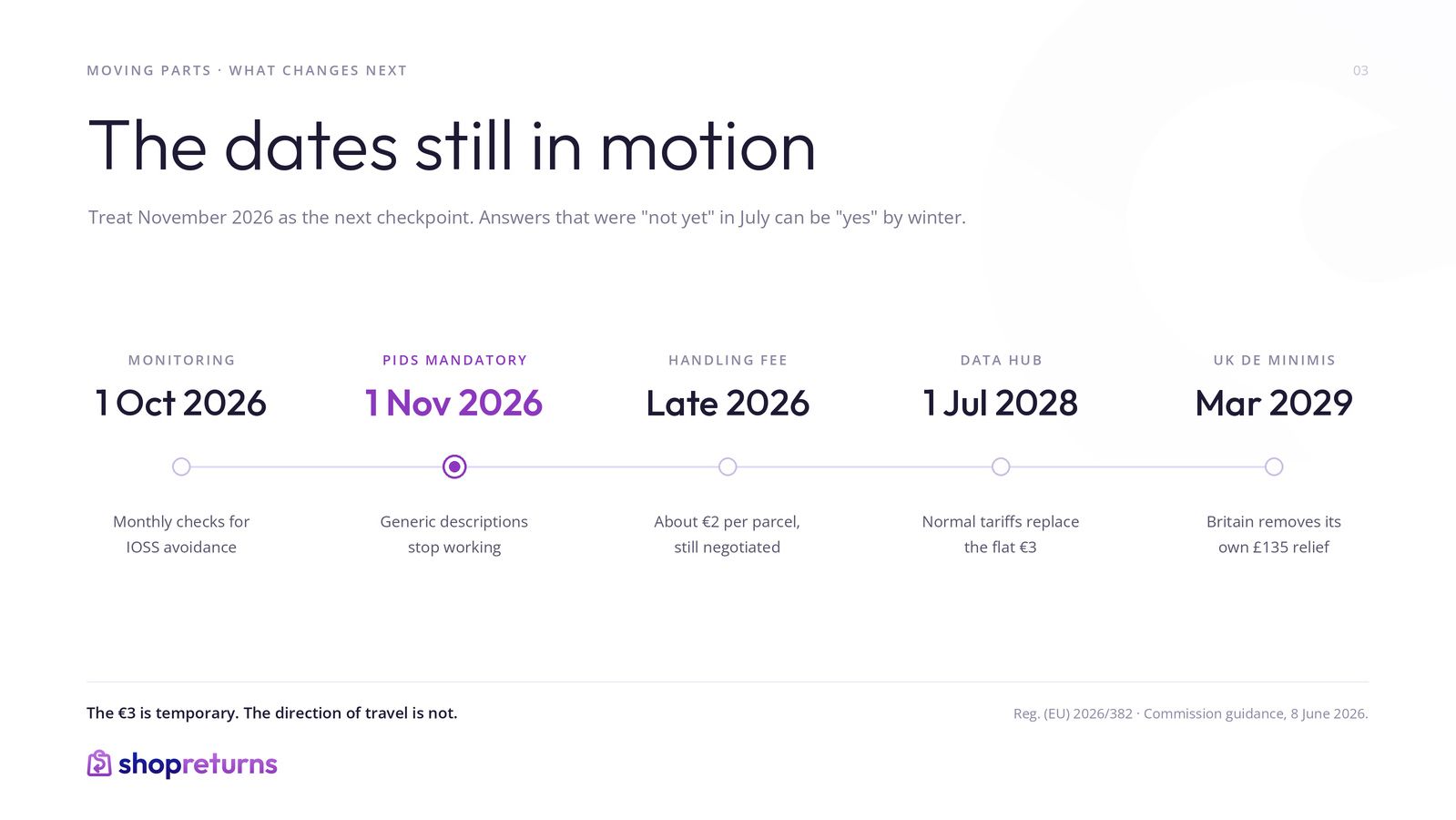
The duty took effect on 1 July 2026, but the Commission's operational guidance was published only weeks earlier, on 8 June, leaving sellers and logistics operators very little time to digest the details. Since Brexit, every UK-to-EU parcel is a customs shipment, so UK sellers feel every rule nuance directly. And the rules keep moving: Product Identifiers become mandatory on 1 November 2026 and a separate EU handling fee is still under negotiation, so answers that were "not yet" in July may become "yes" by winter.
The 15 customs duty questions
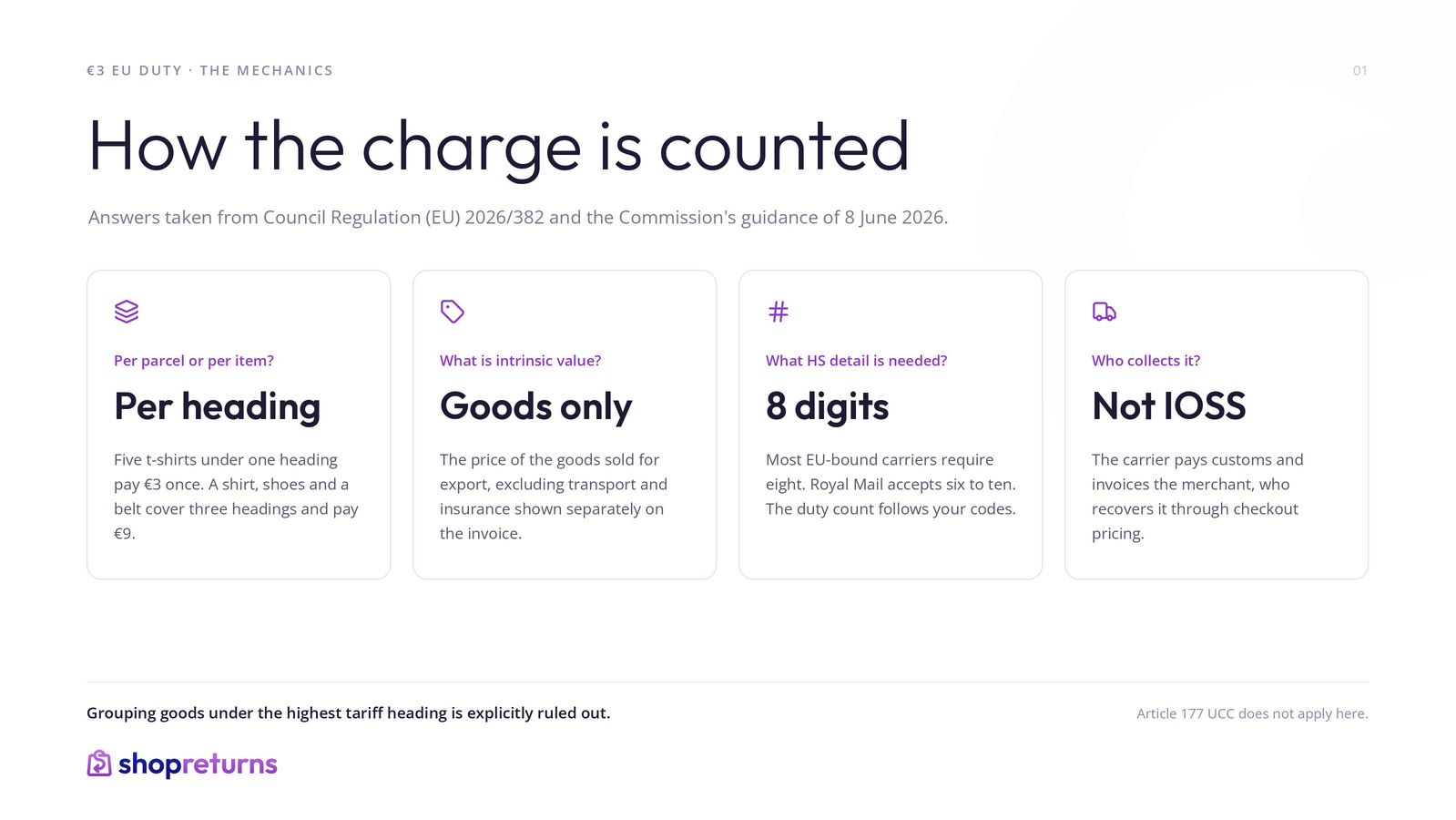
1. Is the €3 charged per parcel or per item? Per item, according to tariff heading, within one consignment. The €3 is counted per item category within a consignment, so five t-shirts under one heading pay €3 as a category, while a parcel with a shirt, shoes and a belt covers three headings and pays €9.
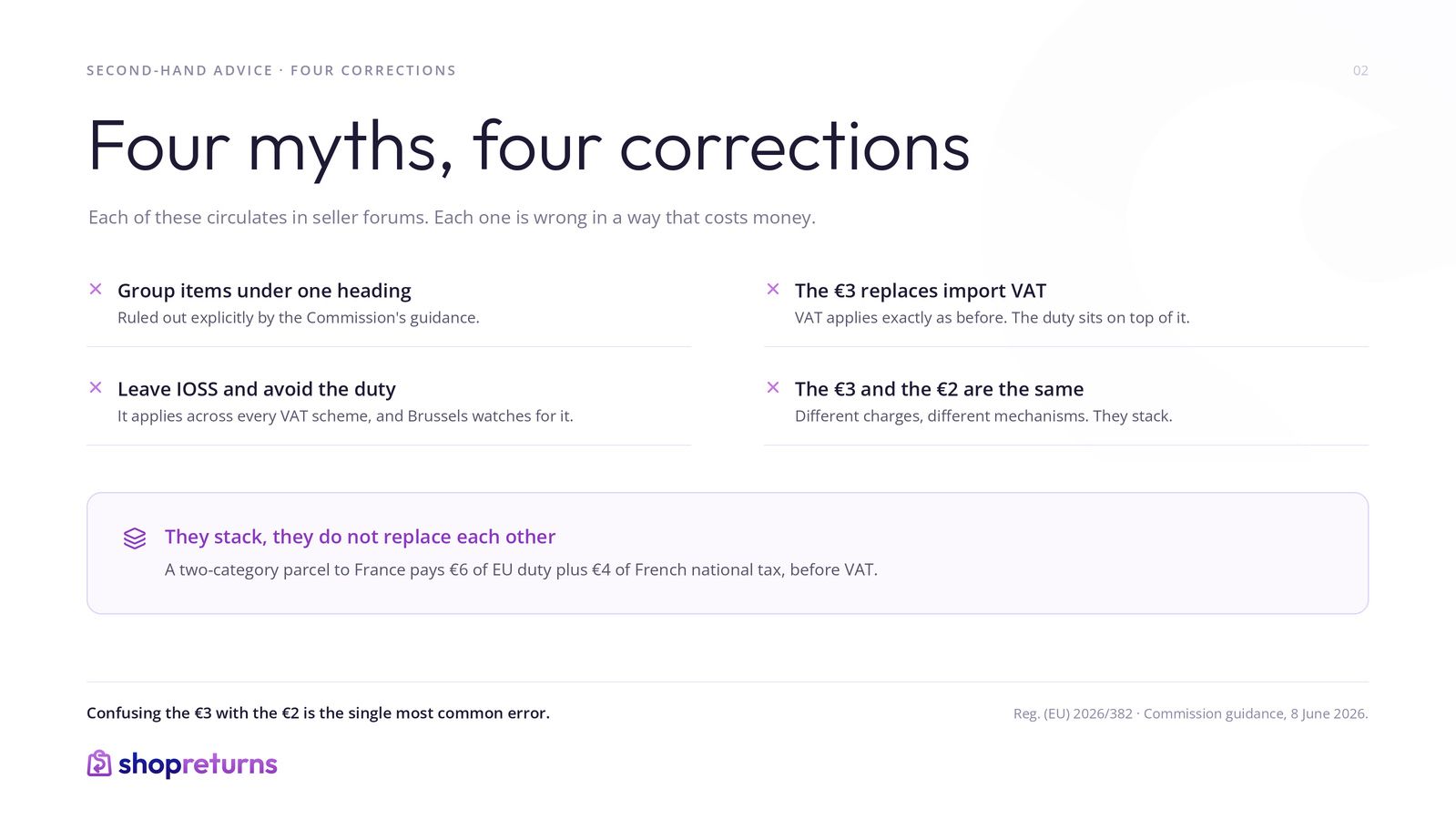
2. Can I group items under one tariff heading to pay once? No. The Commission's guidance explicitly rules out the usual practice of grouping goods under the highest tariff heading (Article 177 UCC) where the €3 duty applies.
3. Which parcels are in scope? B2C distance sales of goods imported from outside the EU with an intrinsic value up to €150, entering the EU from any non-EU country, including the UK. Per the official guidance, it applies regardless of the VAT scheme used: IOSS, Special Arrangements or standard import VAT.
4. What exactly counts as "intrinsic value"? The price of the goods themselves when sold for export to the EU, excluding transport and insurance costs if they are separately indicated on the invoice. A €140 product with €15 shipping shown separately has an intrinsic value of €140 and is in scope.
5. Does the duty replace VAT? No. Import VAT applies exactly as before, declared through IOSS where you use it. Sellers using IOSS still collect and pay VAT at checkout. The €3 is an additional customs duty on top.
6. Who actually collects the €3? It is not collected through IOSS. Under the current guidance, the carrier pays the duty to customs and invoices the merchant, who can recover it through checkout pricing. In practice, the agent declaring the parcel may differ by model, and the subject legally responsible can be the platform, seller, carrier or another intermediary, depending on how customs authorities assign the declaration role.
7. Should I leave IOSS to avoid the duty? No. The duty applies across VAT schemes, and the Commission is separately monitoring, from 1 October 2026, whether sellers are diverting away from IOSS, with the power to propose countermeasures. IOSS still helps streamline customs procedures and supports smoother delivery for EU consumers. IOSS remains the fast-clearance route for import VAT.
8. How long will the €3 last? The 3 customs duty is a temporary new duty from 1 July 2026 until 1 July 2028, when the EU Customs Data Hub is scheduled to apply normal tariff rates to low-value goods. If the infrastructure is late, the temporary duty can be extended.
9. Is the €3 the same as the €2 fee I keep reading about? No, and confusing them is the most common error. The €3 is one of the new customs charges, not an administrative fee. The €2 is a proposed EU handling fee to cover customs processing costs, envisaged per parcel, still under negotiation, possibly arriving in late 2026. Separately, France already charges its own €2 national tax per HS6 code (since March 2026) and Italy a €2 administrative levy.
10. What are PIDs and do I need them now? Product Identifiers (for example GTIN/EAN barcodes, SKUs, manufacturer IDs) are new data elements on import declarations, voluntary since 1 July 2026 and mandatory from 1 November 2026. Generic product descriptions will no longer suffice, so clean product data now saves stranded parcels later.
11. What HS code detail do carriers need? Most EU-bound carriers require 8-digit codes (Royal Mail accepts 6 to 10 digits). Missing or wrong codes cause unexpected duty counts, delays or rejected shipments, because the duty count is literally derived from your classification.
12. Does the duty hit my EU returns coming back to the UK? Returned goods are not subject to the EU's €3 when leaving the EU. A return leaving the EU is an export from the EU and a UK import on arrival, so it does not pay the EU's €3, but it does run a full cross-border customs journey with its own costs and delays. The clean alternative is keeping returns inside the EU at a local return address and consolidating shipments home.
13. What about replacement or exchange parcels I send after a return? A replacement shipped from the UK is a brand new EU import and pays the duty again. Exchanges fulfilled from returned stock already inside the EU avoid the second charge entirely.
14. My customer refused the parcel over doorstep charges. What now? Refused parcels sit in customs limbo, accrue carrier handling penalties and come back as returns. Properly paying import duties upfront reduces refusals from consumers. The prevention is DDP-style pricing where all duties and fees are collected at checkout; the cure is a local EU process that catches refusals before they become write-offs.
15. Is the UK planning anything similar for imports into Britain? Yes. The November 2025 budget confirmed the UK will remove its £135 de minimis by March 2029, after which low-value parcels entering the UK will face customs duties too. The direction of travel is global.
Before you scale e commerce: a practical checklist
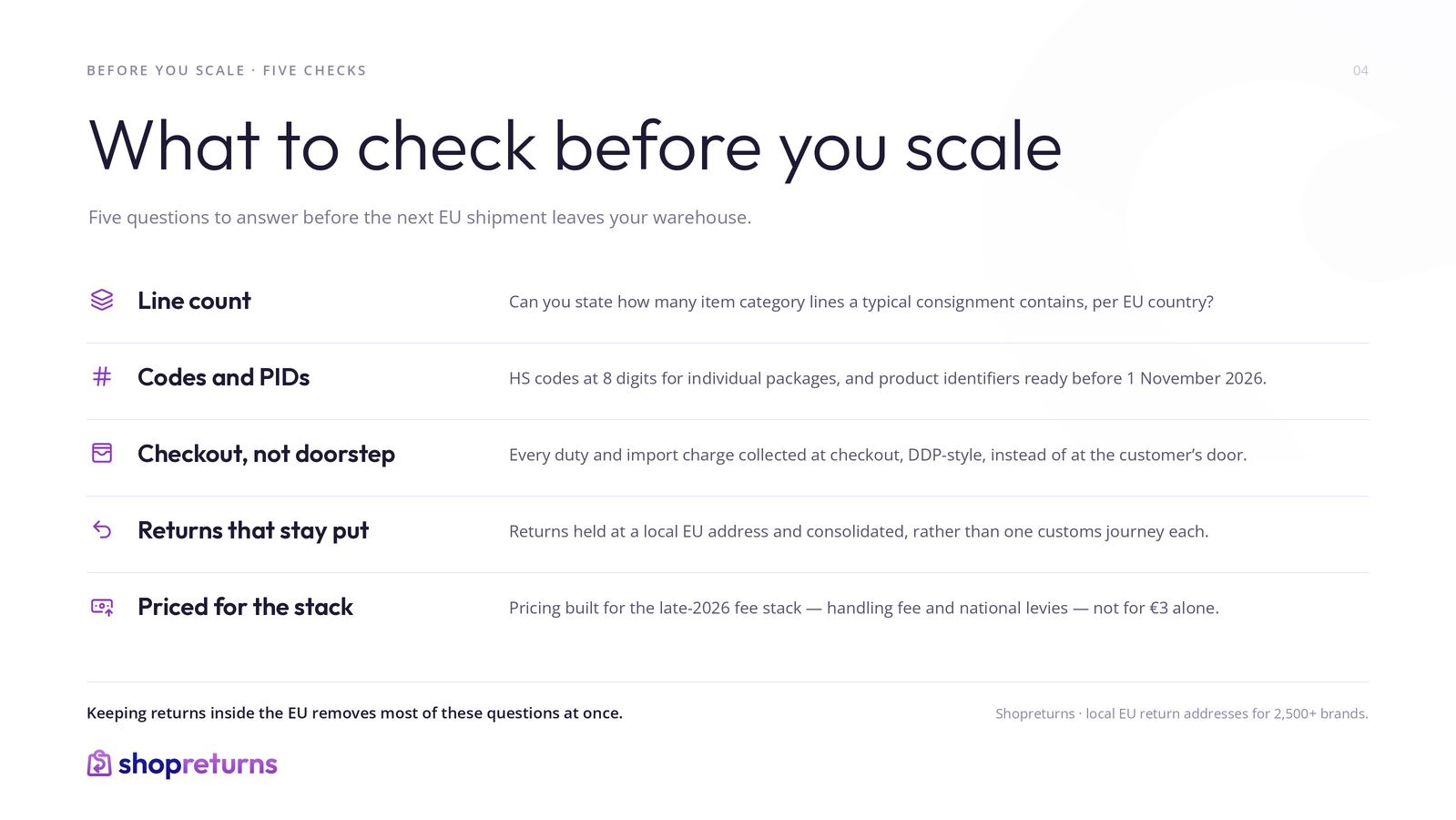
- Can you state, for your typical consignments across different EU countries, how many item category lines they contain?
- Are your HS codes at 8 digits for individual packages and your PIDs ready before 1 November 2026?
- Is every customs charges or import duties amount properly collected at your checkout rather than at the customer's door?
- Do your returns stay inside the EU, or does each one run its own customs journey?
- Have you priced for the fee stack of late 2026, not just for €3, as an e commerce pricing issue?
How does Shopreturns and the
EU customs data hub solve this?
Most of the questions above get simpler when a business avoids repeated customs procedures on returns. Shopreturns provides local EU return addresses for over 2,500 brands, verifies every returned item with photos within 24 hours, fulfils exchanges from stock already inside the EU so no replacement pays the duty twice, reducing delays with customs authorities and supporting smoother delivery, and consolidates the rest into bulk shipments back to the UK with customs clearance handled, which improves processes for sellers shipping from outside the EU.
FAQ
Where do these answers come from? From Council Regulation (EU) 2026/382, the European Commission guidance of 8 June 2026 and Implementing Regulation (EU) 2026/1200, plus official Council and Commission communications; together, the official texts set out the replacement of the previous customs duty exemption for low-value goods, as part of a wider reform that removes low-value import exemptions to combat fraud and protect local sellers.
Will the answers change? Some will. The handling fee decision, the possible extension of scope and the 2028 Data Hub timeline are all moving parts; treat November 2026 as the next checkpoint, with any wider reform timing depending on the relevant implementation date. The €3 customs duty is intended to support fair competition between EU and non-EU sellers.
Can Shopreturns advise on my specific setup? We can review your returns flow and show where the new rules cost you money; for tariff classification and tax rulings, including treatment of low-value gifts, IOSS (Import One Stop Shop) registration for orders up to €150, or other consignments, pair that with your customs broker or tax adviser.
Not sure what your current setup is costing you?
Send us your numbers and we'll run them against the new regime - where the duty hits twice, what return freight costs against the goods you recover, and how much is avoidable.
Keep reading
More from the knowledge base

Are Free Returns Really Driving Growth - or Destroying Your Margins?

The First Black Friday Under the €3 Customs Rules